Best REITs to Invest In 2026: Top Real Estate Investment Trusts to Consider
Investing in real estate does not always require purchasing a house, apartment, or commercial property. Real Estate Investment Trusts (REITs) allow investors to gain…
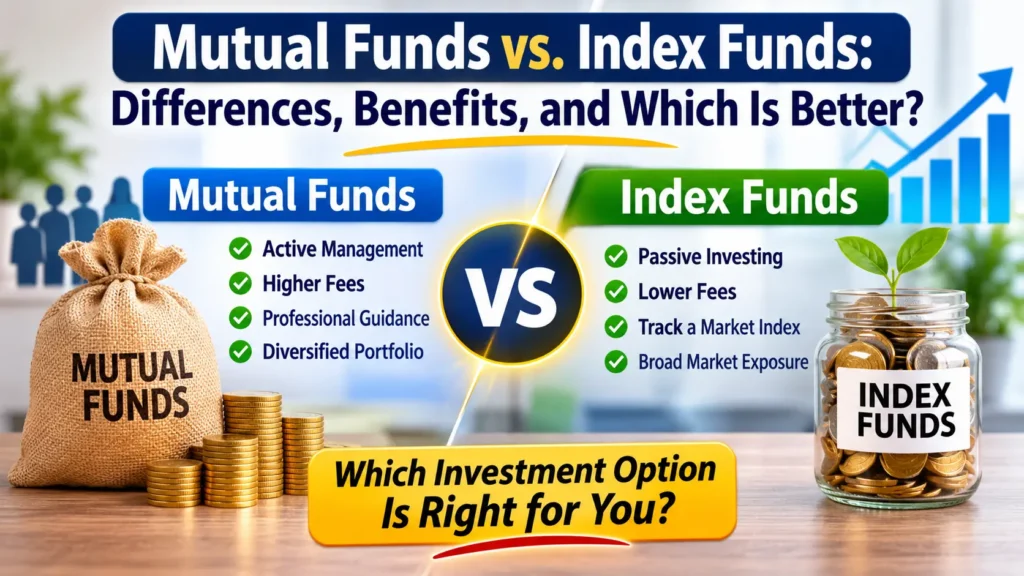
Investing can be an effective way to build long-term wealth, but choosing the right investment can be confusing for beginners. Two popular investment options are mutual funds and index funds. Many investors compare these funds when planning for retirement, building savings, or creating a diversified investment portfolio.
Mutual funds and index funds provide investors with access to a collection of investments, such as stocks and bonds. However, they may differ in their investment strategies, management styles, fees, and long-term performance goals.
One important detail is that an index fund is not necessarily a separate type of mutual fund. An index fund can be structured as a mutual fund or an exchange-traded fund (ETF). The main difference is generally how the fund invests its money.
In this guide, we will explain mutual funds vs. index funds, their advantages and disadvantages, investment risks, costs, and how to choose the right option for your financial goals.
A mutual fund is an investment vehicle that pools money from multiple investors and invests it in a portfolio of securities.
These investments may include:
A mutual fund is managed according to its investment objective. Some funds are actively managed by professional portfolio managers, while others follow a passive investment strategy.
Investors purchase shares of a mutual fund and receive a proportional interest in its portfolio.
When investors contribute money to a mutual fund, the fund combines their investments into a larger portfolio.
A professional fund manager may research companies, evaluate market conditions, and select investments based on the fund’s strategy.
For example, an actively managed U.S. stock mutual fund may invest in companies such as Microsoft, Apple, Amazon, and other publicly traded businesses.
The fund’s performance depends on the value of its underlying investments, its management strategy, and its expenses.
Mutual funds are generally priced once per trading day using their Net Asset Value (NAV).
An index fund is an investment fund designed to track the performance of a specific market index.
Instead of attempting to outperform the market through individual investment selections, an index fund generally seeks to replicate the returns of its chosen benchmark before fees and expenses.
Popular market indexes include:
For example, an S&P 500 index fund aims to track the performance of the S&P 500, which represents approximately 500 leading publicly traded U.S. companies.
An index fund may purchase all the securities in its benchmark or use a representative sample.
Index funds generally follow a passive investment strategy.
The fund manager does not regularly attempt to select the best-performing companies. Instead, the fund invests according to the composition of its selected index.
When the index changes, the fund may adjust its holdings to maintain alignment with the benchmark.
Because index funds usually require less active research and trading, they may have lower operating costs than many actively managed funds.
However, not every index fund is inexpensive, and index investing does not eliminate market risk.
The main difference between an actively managed mutual fund and an index fund is the investment strategy.
| Feature | Actively Managed Mutual Fund | Index Fund |
|---|---|---|
| Investment Strategy | Manager selects investments | Tracks a market index |
| Management Style | Active | Passive in most cases |
| Main Goal | May attempt to outperform a benchmark | Attempts to match benchmark returns |
| Management Fees | Often higher | Often lower |
| Portfolio Changes | May trade frequently | Generally trades less frequently |
| Diversification | Depends on fund holdings | Depends on the index tracked |
| Tax Efficiency | May generate more capital gains | Often more tax-efficient in taxable accounts |
| Performance | Depends partly on manager decisions | Depends on benchmark performance and tracking |
| Risk | Depends on investment strategy | Exposed to risks of the tracked index |
Important: Mutual funds and index funds are not mutually exclusive categories. An index mutual fund is both a mutual fund and an index fund.
Mutual funds are available in different categories depending on their investment objectives.
These funds invest primarily in stocks selected by professional managers.
The goal may be to outperform a market benchmark or achieve a particular investment objective.
These funds may offer opportunities for outperformance, but manager decisions can also lead to underperformance.
Bond mutual funds invest primarily in fixed-income securities.
They may hold government bonds, corporate bonds, municipal bonds, or other debt investments.
Bond funds can provide income, but their values may fluctuate due to interest rates, credit risk, and other factors.
Money market mutual funds invest in short-term, relatively liquid debt securities.
They are often used by investors seeking liquidity and relatively lower volatility compared with stock funds.
However, money market mutual funds are not bank deposits and are not guaranteed by the FDIC.
Index mutual funds follow a passive investment strategy and track a selected market index.
They combine the mutual fund structure with index-based investing.
Examples include funds that track the S&P 500 or a broad U.S. stock market index.
Mutual funds offer several potential advantages.
Actively managed mutual funds employ investment professionals who research securities and make portfolio decisions.
Investors who prefer professional management may find this approach convenient.
A mutual fund can provide exposure to many securities through a single investment.
Diversification may help reduce company-specific risk, although it does not eliminate overall investment risk.
Mutual funds can simplify investing by allowing investors to purchase a diversified portfolio without selecting individual stocks or bonds.
Many mutual funds allow recurring contributions.
This feature can help investors save consistently and develop long-term investing habits.
Mutual funds may also have limitations.
Some actively managed mutual funds charge higher expense ratios than comparable index funds.
These fees reduce the investor’s net returns over time.
An actively managed fund’s performance depends partly on the decisions made by its portfolio manager.
The manager may fail to outperform the fund’s benchmark.
Actively managed mutual funds may sell securities more frequently.
In taxable brokerage accounts, realized gains may be distributed to shareholders, potentially creating tax liabilities.
Investors do not directly choose every security within a mutual fund’s portfolio.
They must rely on the fund’s investment strategy and management.
Index funds are popular among long-term investors because of their straightforward investment approach.
Many index funds have lower expense ratios than actively managed mutual funds.
Lower costs can help investors retain more of their investment returns.
An index fund can provide exposure to a large number of companies.
For example, a broad-market index fund may hold investments across different industries and sectors.
Index funds follow a defined benchmark.
This makes their investment approach easier to understand compared with some actively managed funds.
Index funds generally trade less frequently than actively managed funds.
Lower portfolio turnover may reduce realized capital gains distributions in taxable accounts.
However, tax efficiency varies by fund structure and investment strategy.
Index funds can be useful for investors who want a diversified approach to long-term wealth building without attempting to predict short-term market movements.
Index funds also have risks and limitations.
An index fund generally follows the performance of its underlying benchmark.
If the market index declines, the index fund may also lose value.
Index funds generally do not have the flexibility to avoid individual securities simply because the fund manager expects them to perform poorly.
An index fund may not perfectly match its benchmark.
Fees, trading costs, sampling methods, and other factors can create differences between the fund’s performance and the index.
An index fund aims to track its benchmark rather than beat it.
Investors should not assume that an index fund will always outperform actively managed mutual funds.
Investment fees are an important factor when comparing funds.
An expense ratio represents the annual operating expenses of a fund as a percentage of its assets.
Consider a hypothetical example:
| Investment | Expense Ratio | Annual Cost on $10,000 |
|---|---|---|
| Fund A | 0.10% | $10 |
| Fund B | 0.50% | $50 |
| Fund C | 1.00% | $100 |
In this example, the investor pays $10 annually for Fund A, $50 for Fund B, and $100 for Fund C on a $10,000 investment, assuming the balance remains constant.
The actual cost can change as the investment balance changes.
Over many years, differences in expenses can have a meaningful impact on investment growth.
Investors should review expense ratios, sales charges, transaction costs, and other fees before purchasing a fund.
Both mutual funds and index funds can be suitable for beginner investors.
However, a low-cost, diversified index fund may be attractive to beginners who prefer a straightforward long-term investment strategy.
An actively managed mutual fund may appeal to investors who prefer professional investment selection and are willing to evaluate management costs and performance.
The right choice depends on:
Beginners should focus on understanding the fund’s holdings, fees, and risks rather than choosing investments solely based on recent performance.
Investors can find index funds that track different markets and investment strategies.
Examples include:
This mutual fund seeks to track the performance of the S&P 500 Index.
This fund provides exposure to companies represented in the S&P 500 Index.
This mutual fund seeks to track the S&P 500 Index.
This ETF provides broad exposure to the U.S. stock market and follows an index-based strategy.
These examples are provided for educational purposes only. Funds may differ in expense ratios, share classes, holdings, and investment characteristics.
Past performance does not guarantee future results.
Choosing a fund requires evaluating your financial situation and investment goals.
Determine whether you are investing for retirement, long-term wealth building, income, or another objective.
Review each fund’s expense ratio and other costs.
Lower expenses can improve net returns when other factors are equal.
Determine whether the fund tracks an index or uses active management.
Review its investment objective and portfolio holdings.
Check whether the fund provides exposure to different companies, industries, or asset classes.
Taxable brokerage accounts and retirement accounts may have different tax consequences.
Review potential capital gains distributions and other tax considerations.
Compare the fund’s risk characteristics, benchmark, historical performance, and investment strategy.
Remember that past performance does not guarantee future results.
Yes. An index fund can be structured as a mutual fund or an ETF. It follows an index-based investment strategy rather than attempting to actively select investments to outperform the market.
Index funds may offer lower costs and a straightforward investment strategy. However, actively managed mutual funds may appeal to investors seeking professional investment selection. The better option depends on your financial goals and circumstances.
Many index funds have lower expense ratios than actively managed mutual funds. However, fees vary by fund, so investors should compare actual costs.
Actively managed mutual funds can outperform their benchmarks in some periods. However, they may also underperform. Performance depends on the fund’s investment strategy, manager decisions, expenses, and market conditions.
Not necessarily. Risk depends on the assets held by the fund and the index or investment strategy it follows.
An index fund tracking a stock market index can experience significant losses during a market downturn.
Yes. Investors can hold both actively managed mutual funds and index funds in the same portfolio.
However, review your holdings to avoid unnecessary overlap and ensure that your overall portfolio remains appropriately diversified.
Index funds may be useful for retirement investing because they can provide diversified market exposure and often have relatively low costs.
However, the appropriate investments depend on your time horizon, risk tolerance, and retirement objectives.
Mutual funds and index funds are both investment vehicles that can help investors build diversified portfolios.
Actively managed mutual funds may appeal to investors who value professional investment selection and a strategy designed to outperform a benchmark.
Index funds may be attractive to investors who prefer passive investing, broad market exposure, and potentially lower costs.
The most important factors when choosing an investment fund are its strategy, expenses, diversification, and suitability for your financial goals.
Before investing, review the fund’s prospectus, holdings, fees, and risks. Consider consulting a qualified financial professional if you need personalized investment guidance.
Disclaimer: This article is for informational and educational purposes only and does not constitute financial, investment, or tax advice. All investments involve risk, including the potential loss of principal. Consult a qualified financial advisor before making investment decisions.
Bonus Tax Aggregate Calculator
Dual Scenario Hourly Calculator
Dual Scenario Salary Calculator
What Is a Roth 401(k)? Benefits, Tax Rules, and Retirement Guide
Mutual Funds vs. Index Funds: Differences, Benefits, and Which Is Better?
Investing in real estate does not always require purchasing a house, apartment, or commercial property. Real Estate Investment Trusts (REITs) allow investors to gain…
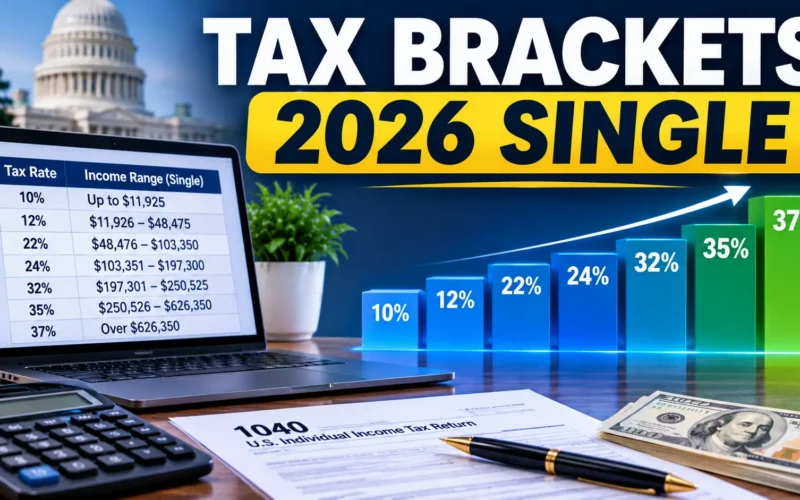
Understanding the 2026 tax brackets for single filers can help you estimate your federal income tax, plan your finances, and avoid surprises when filing…
Saving for retirement becomes especially important as workers approach their 60s. For people who have not accumulated enough retirement savings, making additional contributions to…