Non-Qualified Retirement Plan: How It Works, Benefits, Types, and Tax Rules A non-qualified retirement plan can offer another way to save for retirement by…
Budgeting
RMD by Age Chart: Required Minimum Distribution Rules and Table
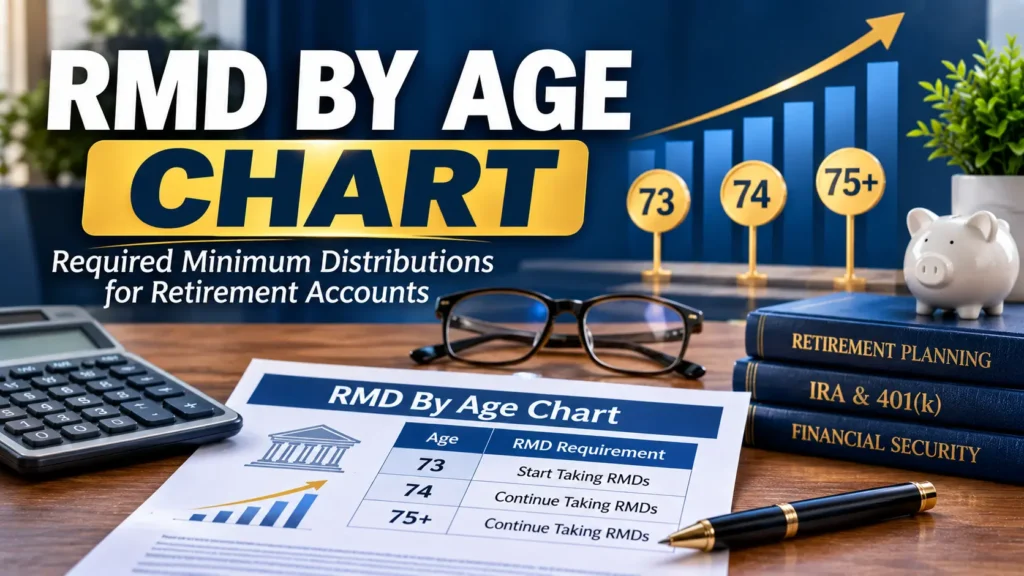
Understanding your Required Minimum Distribution (RMD) is an important part of retirement planning. If you have money in a traditional IRA, 401(k), or another eligible retirement account, federal rules may require you to withdraw a minimum amount each year after reaching a certain age.
The RMD by age chart helps you estimate how much you may need to withdraw based on your age and retirement account balance. Knowing these requirements can help you avoid unnecessary tax penalties and plan your retirement income more effectively.
In this guide, you will learn when RMDs begin, how to use the IRS distribution chart, how to calculate your required withdrawal, and what happens if you miss a deadline.
What Is a Required Minimum Distribution (RMD)?
A Required Minimum Distribution, commonly called an RMD, is the minimum amount that the IRS requires eligible retirement account owners to withdraw each year after reaching the applicable starting age.
RMD rules generally apply to traditional IRAs, SEP IRAs, SIMPLE IRAs, and many employer-sponsored retirement plans, including 401(k), 403(b), and 457(b) plans.
These rules help ensure that retirement savings held in tax-advantaged accounts are eventually distributed and, where applicable, taxed.
RMDs are generally treated as ordinary taxable income when withdrawn from tax-deferred retirement accounts. The exact tax treatment can depend on the account type and whether you have any after-tax contributions.
When Do RMDs Start by Age?
The age when you must begin taking RMDs depends on your birth year and the retirement account you own.
Under current federal rules:
- Born before July 1, 1949: Generally, RMDs began at age 70½.
- Born July 1, 1949, through 1950: Generally, the starting age was 72.
- Born 1951 through 1959: The applicable starting age is 73.
- Born in 1960 or later: The applicable starting age is 75.
Your first RMD is generally due by April 1 of the year after the year you reach your required beginning age. After that, annual RMDs are generally due by December 31.
If you delay your first RMD until April 1 of the following year, you will generally need to take two distributions during that same calendar year.
RMD by Age Chart: IRS Uniform Lifetime Table
The following chart shows the IRS Uniform Lifetime Table divisors commonly used by retirement account owners calculating their own lifetime RMDs. The divisor is based on the age you reach during the distribution year.
| Age | IRS Divisor | Age | IRS Divisor |
|---|---|---|---|
| 73 | 26.5 | 87 | 14.4 |
| 74 | 25.5 | 88 | 13.7 |
| 75 | 24.6 | 89 | 12.9 |
| 76 | 23.7 | 90 | 12.2 |
| 77 | 22.9 | 91 | 11.5 |
| 78 | 22.0 | 92 | 10.8 |
| 79 | 21.1 | 93 | 10.1 |
| 80 | 20.2 | 94 | 9.5 |
| 81 | 19.4 | 95 | 8.9 |
| 82 | 18.5 | 96 | 8.4 |
| 83 | 17.7 | 97 | 7.8 |
| 84 | 16.8 | 98 | 7.3 |
| 85 | 16.0 | 99 | 6.8 |
| 86 | 15.2 | 100 | 6.4 |
Important: This is a simplified reference to the IRS Uniform Lifetime Table. Your applicable divisor may be different if your spouse is your sole beneficiary and is more than 10 years younger than you. Beneficiaries who inherit retirement accounts may also follow different life-expectancy or distribution rules.
How to Calculate Your Required Minimum Distribution
Calculating an RMD is generally straightforward. For most account owners using the Uniform Lifetime Table, divide the retirement account balance on December 31 of the previous year by the IRS divisor for your age in the current distribution year.
RMD Formula:
RMD = Previous Year-End Account Balance ÷ IRS Life Expectancy Divisor
For example, imagine you are 75 years old in 2026 and had $250,000 in your traditional IRA on December 31, 2025.
The IRS Uniform Lifetime Table divisor for age 75 is 24.6.
$250,000 ÷ 24.6 = $10,162.60
Your estimated RMD for 2026 would be approximately $10,162.60.
This is an illustration, not a personalized tax calculation. Your actual RMD depends on your account balance, age, beneficiary circumstances, and the applicable IRS rules.
Which Retirement Accounts Require RMDs?
RMD requirements vary depending on the type of retirement account.
Traditional IRA
Traditional IRA owners generally must take RMDs once they reach their applicable starting age. The required amount is calculated using the previous year-end account balance and the applicable IRS life expectancy divisor.
401(k) Plans
Traditional 401(k) accounts generally require RMDs. However, if you are still working for the employer sponsoring the plan, you may be able to delay RMDs from that current employer’s plan until retirement, provided you meet the applicable requirements. This exception generally does not apply if you own more than 5% of the business.
Roth IRA
The original owner of a Roth IRA is not required to take lifetime RMDs. However, beneficiaries who inherit Roth IRAs may have distribution requirements.
Roth 401(k)
Designated Roth accounts in employer plans no longer require lifetime RMDs for the original account owner beginning in 2024. Beneficiary distribution rules may still apply.
SEP and SIMPLE IRAs
SEP and SIMPLE IRA owners are generally subject to RMD rules similar to traditional IRA owners.
What Happens If You Do Not Take Your RMD?
Failing to withdraw the required amount by the applicable deadline can result in an IRS excise tax.
Under current rules, the tax is generally 25% of the amount that should have been withdrawn but was not distributed. If you correct the shortfall within the applicable correction window, the tax may be reduced to 10%.
For example, if your required distribution was $8,000 but you withdrew only $5,000, the shortfall would be $3,000. The potential excise tax would generally be $750 before considering any available reduction or waiver.
In certain circumstances, you may request a waiver if the shortfall resulted from a reasonable error and you are taking reasonable steps to correct it. Form 5329 is generally used to report the shortfall and request a waiver.
Tips for Managing Your RMDs
Planning ahead can make required distributions easier to manage. Consider these practical steps:
- Check your account balance: Use the balance as of December 31 of the previous year when calculating your RMD.
- Confirm your age and divisor: Select the correct IRS table and divisor for your circumstances.
- Track deadlines: Remember that your first RMD may have a different deadline from later annual distributions.
- Review all retirement accounts: Calculate the RMD separately for each account where required.
- Plan for taxes: Taxable RMDs can increase your annual income, so consider the effect on your tax bracket and other income-related costs.
- Speak with a tax professional: Get guidance if you have inherited accounts, multiple retirement plans, or a younger spouse who is your sole beneficiary.
Frequently Asked Questions About RMDs
At what age do RMDs start?
For people born from 1951 through 1959, RMDs generally begin at age 73. For people born in 1960 or later, the starting age is 75. Earlier birth years follow older starting-age rules.
How do I calculate my RMD by age?
Divide your retirement account balance from December 31 of the previous year by the applicable IRS life expectancy divisor for your age in the current distribution year. Special circumstances may require a different IRS table.
Are RMDs taxable?
RMDs from traditional IRAs and most tax-deferred retirement plans are generally taxable as ordinary income. Qualified Roth IRA withdrawals are generally tax-free, and original Roth IRA owners do not have lifetime RMDs.
Can I withdraw more than my required minimum distribution?
Yes. You can generally withdraw more than the required minimum amount. However, taking extra money in one year does not normally count toward your RMD for a future year.
Can I combine RMDs from multiple retirement accounts?
Traditional IRA owners can generally calculate each IRA’s RMD separately and withdraw the combined total from one or more of their IRAs. Different rules apply to 401(k) accounts and certain other employer-sponsored plans, so you generally cannot combine their RMDs freely.
What is the penalty for missing an RMD?
The standard excise tax is generally 25% of the shortfall. It may be reduced to 10% if the missed amount is corrected within the applicable correction period. A waiver may also be available in qualifying circumstances.
Final Thoughts
An RMD by age chart is a useful retirement planning resource because it helps account owners understand how much they may need to withdraw from tax-deferred retirement savings. Your required distribution generally increases as you get older because the IRS divisor becomes smaller.
Review your retirement account balances, confirm the correct starting age, and use the appropriate IRS life expectancy table each year. Planning ahead can help you meet distribution deadlines, manage taxable income, and avoid unnecessary penalties.
RMD rules can be different for inherited accounts, spouses, and certain employer-sponsored plans. Always confirm your individual requirements using current IRS guidance or consult a qualified tax professional before making a withdrawal.
Use These Useful Calculators:
Bonus Tax Aggregate Calculator
Dual Scenario Hourly Calculator
Dual Scenario Salary Calculator
Standard vs. Itemized Deductions: Which Is Better for Your 2026 Taxes?